
Mold remediation in Cape Coral, FL
Mold remediation in Cape Coral means taking out mold growth and the damp material feeding it, then drying the house so it doesn't come back. In Florida, remediating more than 10 square feet takes a state mold remediator license. Call to reach an independent local company, and check its license on the DBPR search first.
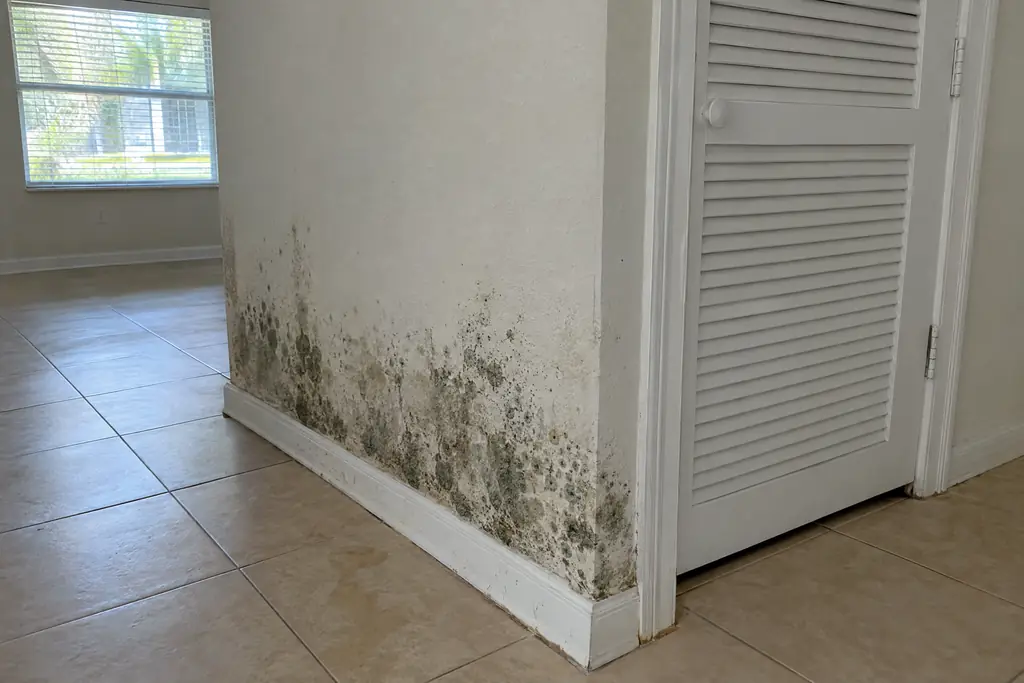
Illustrative photo, not a real job.
Right now
- 1Find and stop the water first: an AC drain pan, a supply line, a roof leak. Mold keeps growing while the material stays wet.
- 2Leave the mold alone. Scrubbing or sanding it throws spores into the rest of the house.
- 3If the mold is in or around the air handler, ask before running the AC; the EPA says not to run an HVAC system you suspect is contaminated.
- 4Photograph the area and the source for your records, with something for scale.
How the job goes, and your part in it
What the company should do
1. Find the moisture
Moisture meter readings around the growth show how far the water spread inside the wall, which decides how much comes out.
2. Contain the area
Plastic sheeting and negative air pressure keep spores in the work area while material comes out.
3. Remove and clean
Moldy drywall, insulation and baseboard that can't be cleaned are cut out and bagged; framing is cleaned and treated.
4. Dry and check
Dehumidifiers bring the framing back to normal dryness, checked with readings before the wall is closed.
What you do
1. Fix the source
A clogged AC condensate line or a slow supply-line drip will regrow mold in the new drywall. That repair is a plumber or AC technician's job.
2. Ask about the license
Over 10 square feet, ask for the Florida mold remediator license number and look it up on the DBPR search.
3. Keep testing separate
If you want mold testing, hire the assessor on its own: Florida bars an assessor from remediating a home it assessed in the past 12 months.
4. Keep the paperwork
Ask for the moisture readings and the scope in writing, and keep your own photos.
Why Cape Coral houses grow mold
Mold needs wet material and warm air, and a Cape Coral house supplies the warm air most of the year. The usual starting points are an air handler closet where the condensate line backed up, drywall that stayed wet after a storm, and bathrooms that never dry. Homes that took on surge or rain water in Ian, Helene or Milton can show it later behind baseboards that were never opened.
The EPA's rule of thumb is to dry wet materials within 24 to 48 hours. In humid air, a soaked wall in a closed-up house won't do that on its own, which is why drying equipment goes in on the first visit. (EPA: A Brief Guide to Mold, Moisture and Your Home)
What Florida law says about mold work
Florida defines mold remediation and mold assessment as work on more than 10 square feet of mold, and both need a state license under chapter 468, part XVI. (Fla. Stat. 468.8411)
A mold assessor or its company may not remediate a home it assessed within the previous 12 months, and assessors and remediators may not pay each other for referrals. Those rules keep the person diagnosing the problem from profiting on the fix. (Fla. Stat. 468.8419)
Mold testing and mold removal are different jobs
A lot of Cape Coral searches are for mold inspection or testing. Testing can tell you what is growing and where; it doesn't remove anything. If the mold is visible and over about 10 square feet, the EPA's guidance is that it needs a professional with that experience either way. (EPA: Mold Cleanup in Your Home)
Cape Coral facts for this problem
- Florida requires a mold remediator license for remediation of more than 10 square feet of mold. (Fla. Stat. 468.8411)
- A Florida mold assessor may not remediate a home it assessed in the past 12 months. (Fla. Stat. 468.8419)
- The EPA puts the indoor humidity target below 60 percent, ideally 30 to 50 percent. (EPA: A Brief Guide to Mold, Moisture and Your Home)
- At Fort Myers Page Field, June through September bring 38.47 in. of the normal year's 57.41 in. of rain, about 67 percent (1991 to 2020 normals). (ACIS daily record, Fort Myers Page Field (USW00012835), calculated by Cape Coral Water Damage Finder on November 13, 2026; method)
- Median year built ranges from 1982 in ZIP 33904, where 46 percent of homes predate 1980, to 2006 in ZIP 33993. (U.S. Census Bureau, ACS 5-year 2020-2024, tables B25034 and B25035, calculated by Cape Coral Water Damage Finder on November 13, 2026; method)
- Fort Myers Page Field averaged 121 days a year at 90°F or hotter from 1991 to 2020 (28 years with nearly complete records), so air handlers in Cape Coral run, and make condensate, for much of the year. (ACIS daily record, Fort Myers Page Field (USW00012835), calculated by Cape Coral Water Damage Finder on November 13, 2026; method)
See also today's humidity and rain in Cape Coral.
What a written estimate should list
- Containment (plastic sheeting, zipper doors) and negative air with a HEPA unit
- Removal and bagging of moldy drywall, insulation and baseboard, by square foot
- HEPA vacuuming and cleaning of exposed framing
- Antimicrobial treatment of cleaned surfaces
- Dehumidifier days and daily moisture readings
- Disposal
No prices here on purpose. For a scope with your own numbers, run the water damage estimator with this problem filled in.
Insurance, in plain terms
Mold that follows a sudden covered leak is often handled with that leak, but many policies cap mold or exclude mold from long-term moisture. Read the mold section of your own policy; it decides.
General information, not insurance advice. More in Cape Coral flood insurance and water damage coverage.
Related water problems in Cape Coral
Questions about mold remediation in Cape Coral
Is a small mold spot something I can handle on my own?
The EPA says a homeowner can usually handle an area smaller than about 10 square feet, roughly a 3 foot by 3 foot patch. Over that, after heavy water damage, or where sewage or flood water caused it, it points to a professional.
Do I need a mold test before remediation?
Not when the mold is visible and you know where the water came from. If you do want testing, use an independent assessor: Florida law keeps an assessor from remediating the same home within 12 months.
Why does mold come back after it was cleaned?
Because the water source wasn't fixed or the framing wasn't dried before the wall was closed. Ask for moisture readings that show the wall dried before new drywall goes up.
Call and you're connected with an independent local company that takes calls for your ZIP.
(239) 323-3012